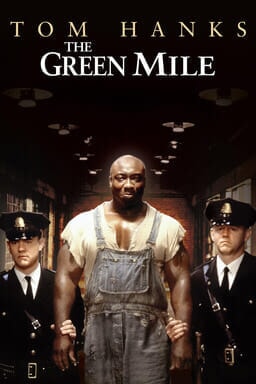
ABOUT THE STORY...
"The Green Mile" is told in a flashback narrated by Paul Edgecomb to his friend Elaine Connelly. Edgecomb is now living in an old-age home some six decades after working as the head guard on Death Row at Cold Mountain Penitentiary.
Edgecombs tour of duty at Cold Mountain in the Depression-era South included watch over a quartet of killers awaiting their final walk down "the Green Mile," the stretch of green linoleum flooring that took convicts from their jail cells to the electric chair.
Over the years, Edgecomb walked the mile with a variety of cons. He had never before encountered someone like John Coffey, a massive black man convicted of brutally killing a pair of nine-year-old sisters. Coffey certainly had the size and strength to kill anyone, but his demeanor starkly contrasted with his appearance. Beyond his simple, naive nature and a deathly fear of the dark, Coffey seemed to possess a prodigious, supernatural gift. Edgecomb began to question whether Coffey was truly guilty of murdering the two girls.
As the story unfolds, Paul Edgecomb learns that, sometimes, miracles happen in the most unexpected places.
* * * *
Filmmaker Frank Darabont was hooked on The Green Mile after reading just the first of six installments of Stephen Kings novel. The bestselling author composed the story in a manner he had never tackled before, releasing it in serialized form over a period of six months between April and September, 1996.
The format thrilled readers, who took each of the six chapters to the top of the paperback bestseller list during the course of the year. When the sixth and final chapter (subtitled "Coffey on the Mile") hit bookstores on September 9, King achieved a rare triumph -- all six installments of The Green Mile appeared simultaneously on the Publishers Weekly national bestseller list.
In looking back on the novels success, King admits that the story "was very difficult for me to write." Two years before he actually began composing the novel in 1995, he had outlined a story involving the electric chair and a black inmate named Luke Coffey, a magician whose secret powers could possibly be used to make himself disappear before walking the Mile.
King changed his conception of the magician character and his "idea for a story became The Green Mile. I just hoped I wouldnt run out of inspiration before it was done. In a lot of ways, dealing with John Coffey was a difficult thing to do. Here is a man on Death Row who may be innocent, who is able to help some of his fellow captives. That was the basic idea of the story."
Once King began to write, he chose to release his new novel in serial form. Inspired by literary giant Charles Dickens, who published many of his works in this manner, King relates, "I always loved stories told in episodes. It is a format I first encountered in the Saturday Evening Post.
"When The Green Mile was published, nobody had attempted a serial novel in the U.S. since the 20s. When the first episode, The Two Dead Girls, was to go on sale, I thought to myself, Ive made the biggest mistake of my life. Nobody had any idea that it would succeed to the level it did, least of all me."
But, in composing his work in such a format, King also confesses the advantage he enjoyed over his audience by publishing The Green Mile in episodic form. "In a story which is published in installments...simply put, you cannot flip ahead and see how matters turn out. That is an appeal that I suspect only the writer of suspense tales and spooky stories can fully appreciate."
Prior to the publication of the books in 1996, Darabont knew that King had embarked on this new assignment. The pair "chatted on the phone, and (Stephen) mentioned he had this idea for a new story, and gave me a 30-second description of it," the filmmaker remembers. "It sounded so fantastic to me. I told him to write it and give me first crack at it, which he did. So I heard the genesis of this from Steve before he actually sat down to write it. But I had to wait and read all six books on a monthly basis, just like everyone else."
"I read the first installment, jumped on a plane and flew to Colorado where King was doing the miniseries The Shining," Darabont recalls. "I drove up a mountain just like Jack Torrance in The Shining to try and find Stephen and say Yes, I really want to do this.
"Im a big fan of all his stuff," Darabont declares. "I have been since I read The Shining in high school. Since then, Ive read everything that hes done. Stephen has a certain way he tells a story that really speaks to me on some deeper level. Like Shawshank, this is more earthbound, a little less in the realm of the fantastic and a little more in the realm of the human heart."
For his work on "The Shawshank Redemption," Darabont won nominations (in addition to the Oscar nod) from the Writers Guild and Directors Guild as well as winning the Humanitas Award and the Scriptor Award from the University of Southern California.
"I knew Frank from when he was doing student films," King recalls. "He wanted to make a film from a story of mine called The Woman in the Room, and I gave him permission.
"And Frank made a glorious film," King enthuses. "He then came to me to take a shot at adapting Rita Hayworth & The Shawshank Redemption. He did the screenplay pretty much on spec, sent it to me and I read it. It was just a mind-blowing piece of work." Five years after that triumphant feature-film debut, Darabont chose as his next big-screen project another King tale set behind bars.
"The fact that this is another Stephen King prison film was the luck of the draw," Darabont contends. "This just happened to be the one thing I found that I loved. Yes, its another Stephen King prison movie, the most obscure niche in motion picture history." Adds King, "Frank jokes and says that he has the worlds smallest specialty -- he makes only Stephen King prison movies set in the past."
"When (Stephen) spoke of the relationship between John Coffey and the head of Death Row, it certainly piqued my interest," Darabont says. "Like Shawshank, this story is uplifting, but this has a much more complex tone. Its also got a sort of lovely melancholy thing going on. Im looking for something that is hopeful, and thats what I find attractive in these stories. I want something my heart can believe in."
For King, "Shawshank was a brighter story than this one. This one has more in common with some of the stranger tales Ive written. But theres a feeling that, in The Green Mile, the human spirit is alive and well, even under the most difficult circumstances. Sometimes, the more difficult life becomes, the more the human spirit has a chance to shine."
So it was back to prison for Darabont when he returned to the directors chair for the first time in five years.
ABOUT THE CAST AND CHARACTERS
Darabont and Tom Hanks met in 1994 at the Academy Awards nominees luncheon, Hanks attending on behalf of his nomination for "Forrest Gump," and Darabont representing rival nominee "The Shawshank Redemption."
Recalls Hanks, "I couldnt believe Franks movie when I first saw it. I was utterly transported by this prison movie. For that to be somebodys first movie is a miraculous achievement. And I liked his sensibilities.
"With Stephen King, you think youre going to get this very particular brand of horror story, and this is really not that," Hanks adds. "This is more like a mystery than anything else, not unlike the better aspects of The Shawshank Redemption. Im usually a great stickler for turning things down because I dont understand why the (characters) are doing what theyre doing. With Paul Edgecomb, the logic is perfect."
For King, meeting Tom Hanks, who portrays his storys narrator, may have been like hearing his own voice inside his head. The author seems to have had Hanks in mind when he wrote his prison saga. "Paul Edgecomb is a Stephen King narrator if there ever was one," King says. "Tom fits like an old shoe. The minute that Frank mentioned his name to me, I thought, this cant be, its too good to be true."
"Sometimes when youre writing, you have an actor come into your brain for a given role," Darabont enthuses. "I got most of my first choices on this, which is unheard of. Youre lucky to ever get one. The bottom line is, its fantastic material and an amazing cast."
About his character, Tom Hanks says, "Pauls job is to keep things quiet and calm on the Green Mile until the moment comes when he takes a human being and, as officially as possible, shepherds him from this place into the hereafter. But Paul cant deny the fact that John Coffey is not your standard inmate on Death Row. It shakes Pauls confidence in his own ability to carry out his job."
David Morse, who previously starred in the television adaptation of Kings novella, The Langoliers, had not heard about Darabonts script before being asked to play Brutal Howell, Edgecombs kind-hearted enforcer on the Mile. "I heard it was a Stephen King script, and you never know what to expect. I was weeping by the end of reading it."
"John Coffey is one of the biggest men that anybody has ever seen," actor Michael Clarke Duncan offers about his first motion picture starring role. "Hes seven feet tall and 330 lbs an apparent cold-blooded murderer with two dead girls in his arms. But John Coffey is also a very special individual who understands Paul, sees the kindness that is in Paul and most of the other guards. And thats kind of the ironic twist to it."
For Duncan, playing the central role was certainly a dream come true. "Im used to being the big tough guy, the bodyguard type," the actor says. "I had never taken on a role like this. I started reading the novel and couldnt put it down. I got emotional while reading it. Once I finished it, I said, Thats me. I dont care what I have to do, but Ive got to play this role."
In contrast with his well-known supporting cast, Darabont chose this virtual unknown to star opposite Tom Hanks. "This will be the movie that makes Michael Clarke Duncan known to moviegoers," he announces. "I always felt when casting the character that he should be a fresh face, and it was really delightful to find him."
"It was wonderful, just wonderful," Duncan declares. "In Armageddon I went to work every day with Bruce Willis, Billy Bob Thornton, Ben Affleck, Steve Buscemi. Here I worked with Tom Hanks, David Morse and all those guys. I was surrounded by talent and I drew off them. They didnt know what to expect from me when I first got there. I was the rookie."
For the crucial role of Warden Moores, director Darabont wanted Academy Award-nominee James Cromwell from the very first. "Its very rare that you read a script and weep," Cromwell says. "I read it and was profoundly moved by it, and every time I reread it, I was again profoundly moved by it. Then to go in and hear Frank say that he wanted me for the part was magic."
"His predicament is really interesting," Cromwell continues. "To be surrounded by death, to be touched by it, it just becomes a process. My character is desensitized by it, but not insensitive to it. Then, to have death suddenly visit him (through his wifes illness), the story becomes bittersweet and grim. That moved me a lot."
"The story deals with last things," observes Michael Jeter, who plays the role of the Cajun Eduard Del Delacroix. "Dels a man whos been sentenced to death by electrocution. As King says, the man who committed that crime is long gone. Hes now just a lonely little man who formed some profound attachment, probably the first real attachment in his life, with this mouse."
To prepare for his role in "The Green Mile," Jeter had to mimic what someone facing an unsavory death would do. He looked to one of the great actors of the century for his inspiration.
"How do you give up your attachment to life?" he inquires. "Especially in an environment that is not particularly kind, when you know the end will be very, very painful. The best quote I ever heard in my life from an actor, when asked how he prepares for a role, was from Sir Ralph Richardson. He said, I plant my feet firmly on the ground and I dream."
Kings story included a native American. Arlen Bitterbuck is the first of the four inmates to "walk the Mile" in the story. "Although theres very little mentioned about Arlen in the book, he represents impending death," says Oscar-nominated co-star Graham Greene.
The interesting bad guy, guard Percy Wetmore, one of two evil characters in Kings story, was eventually embodied by actor Doug Hutchison, who may be best known for two distinctive roles -- as Pete Willard, one of two redneck rapists, in the big screen adaptation of John Grishams "A Time to Kill," and Eugene Tooms, the liquid villain, in several episodes of televisions "The X-Files."
"Percy is the guard everyone will love to hate," actor Hutchison says about his role, which King described in the book as "the kind of boy whod like to go to the zoo, not to observe the animals in their cages, but to throw rocks at them." Now Percy walks the Mile observing a different kind of caged animal. "Because my uncle is the governor, I have the political connection, and can do whatever I want."
Playing the sociopathic killer, Wild Bill, is award-winning actor Sam Rockwell ("Box of Moonlight," "Lawn Dogs") who, like many of his fellow cast members, was not familiar with Kings source material.
Rockwell says, "With King, everything is mythological, very profound. And Im kind of like Huck Finn and the devil mixed together, like Peter Pan and Satan. There is a real playful element to Billy, but he is mean and sadistic. He just hates people. He just wants to kill everybody. Everyone calls him Wild Bill, and thats not something he likes. He wants to be called Billy the Kid."
"There are actually women in this movie as well," director Darabont points out about co-stars Bonnie Hunt, playing Hanks devoted wife, and Patricia Clarkson as the wardens dying spouse.
Hunt, a comedic actress who began her career with Chicagos famed Second City improvisational troupe, loved "this ensemble piece. Its a great story with great characters, a great period peice. Even though King scared the hell out of us, to truly scare people, you must be able to touch something in them that is truly emotional and centered."
For Clarkson ("High Art," "The Untouchables,"), the film marked a reunion with producer David Valdes, who cast her in her second big-screen effort, "The Dead Pool." The role of Melinda Moores, says Clarkson, "is odd because you dont see a lot of her. She is a poignant character and important to some degree. But its a beautiful character, and that Frank managed to capture that in just two scenes is rare."
"I was incredibly flattered that they would hire me for such a wonderfully cast ensemble piece," Barry Pepper says. "And, having worked with Tom Hanks before on Saving Private Ryan, I leapt at the opportunity to work with him again." Adds director Darabont, "When looking to cast Barry, I called Steven Spielberg for a recommendation and he said yes. I asked Tom also, and he said yes. Who was I to argue?"
"Dean is not a real eager participant on the Mile," Pepper adds. "Hes probably the most sensitive of the group of characters. I think the character brings a lot of sensitivity to the story."
Darabont agrees with Pepper, saying, "Barry has such an innate sweetness and made a perfect Dean, probably the most sensitive of the guards."
Veteran actor Jeffrey DeMunn had just completed a King miniseries called "Storm of the Century" before reuniting with director Darabont for their fourth project together (he played the prosecuting attorney who helps convict Tim Robbins banker at the start of "The Shawshank Redemption"). Here, he continues his association with Darabont by playing Harry Terwilliger, one of a quartet of Death Row guards who form an unusual relationship with the inmate Coffey.
DeMunn relates, "This project, as well as Shawshank, seem to be slight exceptions [for King]. I think Stephen has a sweetness about him, a warmth to him. It may be an odd thing to say about King, with all the ghouls and attacking dogs and everything. But, in terms of his view of humanity and our struggle to survive that we all endure, there is that sweetness."
ABOUT THE PRODUCTION
Filmmaker Darabont managed to condense Kings six-part novel into a viable screenplay in just eight weeks, the same time it took him to write his adaptation of "The Shawshank Redemption."
Darabont and company then stepped onto the precisely detailed Death Row set. Production designer Terence Marsh also conceived Darabonts prison design in "The Shawshank Redemption." Marshs "Green Mile" was comprised of only eight jail cells, a distinct contrast to the huge cellblock of 200 cells he constructed for "Shawshank."
Darabont states, "if anybody in this production deserves a nomination for his work, its Terrence Marsh. There isnt a single interior in this movie, with the minor exception of the wardens office, that wasnt designed and built from scratch - - every nut, bolt and frayed electrical cord. And there want a single exterior location that wasnt substantially reinvented for purposes of filming. When Stephen King walked onto the cellblock set for the first time, he said it was like being turned loose inside his own head, that it was like taking a walk inside the country of his own imagination. Coming from the author of the book, youll not find higher praise than that."
"Frank and I specialize in prison pictures," Marsh jokes. "From a design standpoint on this film, we were mainly concerned with such a confined area. Its just the guys on Death Row, which is the Green Mile. On Shawshank, we were out in the exercise yard, and one had a sense of the whole prison, this whole environment."
In researching locations for his designs, the scouts took Marsh and director Darabont back to the now-shuttered Tennessee State Penitentiary, which the pair had looked at back in 1993. Darabont had previously considered this site for "The Shawshank Redemption," opting instead for the Gothic reformatory in Mansfield, Ohio, which has now been largely razed.
The old Tennessee State Penitentiary has become somewhat of a celebrity itself, housing such Hollywood productions as the HBO movie "Against the Wall" (for which it was painted red) and Bruce Beresfords "Last Dance" with Sharon Stone During the week the company filmed there, many of the cast and crew ended up touring the penitentiarys old Death Row building, Unit 6, a low, one-story rectangular stretch of brick that sits adjacent to the main administration building. Among its many inhabitants over the years was felon James Earl Ray.
Marsh and Darabont also visited several other Southern penitentiaries to research a variety of Death Row cell blocks, many of which "were literally these narrow corridors with low ceilings and these little boxes off to the side. They were not pictorially interesting."
"We tried to give our set a sense of space," Marsh says. "A sense of history. And a sense of mystery, in a way. We chose the elongated cathedral-like windows because there is a very mystical element in this movie, a supernatural element, which we didnt have in Shawshank. It presented us with lots of opportunities."
Marshs set also contained another grim reminder of the storys eerie atmosphere -- a spooky replica of a mahogany-and-copper electric chair fashioned from an amalgam of electric chairs he researched at New Yorks Sing Sing, plus prisons in Alabama, Louisiana, Tennessee and Georgia. Marsh and his art directors borrowed characteristics from each to create their own unique instrument of death, building three separate chairs for the film.
"The prisons that we scouted often had their chairs preserved," Marsh recalls. "Its pretty horrible, the whole idea of getting executed, let alone electrocuted. What we used is interesting and quite scary, but not based on one particular chair. King described it very well in the book."
In addition to the prison, the company filmed in several exterior locations in Middle Tennessee, including Shelbyville, Lewisburg, Nolensville, Williamsport and the Caney Fork River, many of which were more than 60 miles from the state capital. The filmmakers also spent a brief period in Blowing Rock, North Carolina, for the nursing home exteriors.
Because the story was set in Louisiana, the filmmakers secured one of the industrys best dialect coaches to guide the flow of the actors accents during filming. Veteran speech coach Jessica Drake once again collaborated with Tom Hanks ("Forrest Gumps" Alabama dialect) and actor Gary Sinise, who joined the production for a two-day cameo as Coffeys lawyer.
Actor Cromwell, who had initially met Drake on the set of "L.A. Confidential" (she worked with Aussie actor Russell Crowe to create a 1950s Los Angeles sound), had, coincidentally, adopted his dialect "from a man who was a judge and state senator when Huey Long was in the legislature. I also borrowed from William Faulkners Nobel acceptance speech. Although Faulkner was from Mississippi, he was very much like Robert Penn Warren, who was from Louisiana."
Drake says, "Since its 1935, we tried to find a period sound using much older people. I then broke that down phonetically, like writing a spoken sound, or scoring music. I then found the common patterns and figured out what to do with the actors to bring them to that sound."
For Karyn Wagner, the accent was on the costumes. With Kings story set in the 1935 Depression-era South, Wagner had her work cut out for her in reuniting with director Darabont, for whom she designed the wardrobe on his HBO telefilm, "Black Cat Run," produced by Darabont and directed by D.J. Caruso. (She is also a former classmate of his, who met the budding filmmaker in a production of "Hello, Dolly!" at Hollywood High).
"The clothes were very much a part of the story," Wagner explains. "In researching the period, Frank looked at photographs of Walker Evans, that kind of Depression-era photography. And that was to be the basis of what we built the film on visually. I found out that in 1935, most prisons did not have uniforms; Sing Sing was the only prison in the U.S. that actually did. Most prison guards wore either suits or khaki pants and shirts."
She continues, "Frank and I had a long discussion about this. The audience needs to understand that the guards were authority and the inmates were prisoners; it makes the relationship between Paul and Coffey that much more poignant. So we decided to put the guards in uniforms. I sort of extrapolated a little bit from the Army, a little bit from Sing Sing and a little bit from police of the period and amalgamated bits and pieces I liked into the guard uniforms."
While Kings novel was set in 1932, Darabont changed the time frame to 1935. "There is a certain point in the story when we see a film projected, a contemporary film of the time. I desperately wanted to use Top Hat which was 1935," says Darabont.
David Valdes negotiated with Mrs. Fred Astaire to obtain a film clip of her husband dancing with longtime partner Ginger Rogers. And Darabont had one specific sequence in mind -- the couples dance set to Irving Berlins tune, "Cheek to Cheek."
Castle Rock Entertainment Presents A Dark Woods Production: Tom Hanks in "The Green Mile," starring David Morse, Bonnie Hunt, Michael Clarke Duncan, James Cromwell, Michael Jeter, Graham Greene, Doug Hutchison, Sam Rockwell, Barry Pepper, Jeffrey DeMunn, Patricia Clarkson, Harry Dean Stanton, Dabbs Greer and Eve Brent. The music is by Thomas Newman; the costume designer is Karyn Wagner; and the film is edited by Richard Francis-Bruce, A.C.E. The production is designed by Terence Marsh and the director of photography is David Tattersall, B.S.C. "The Green Mile" is based on the novel by Stephen King, and is produced by David Valdes and Frank Darabont. It is written for the screen and directed by Frank Darabont. The film is distributed by Warner Bros., A Time Warner Entertainment Company.